
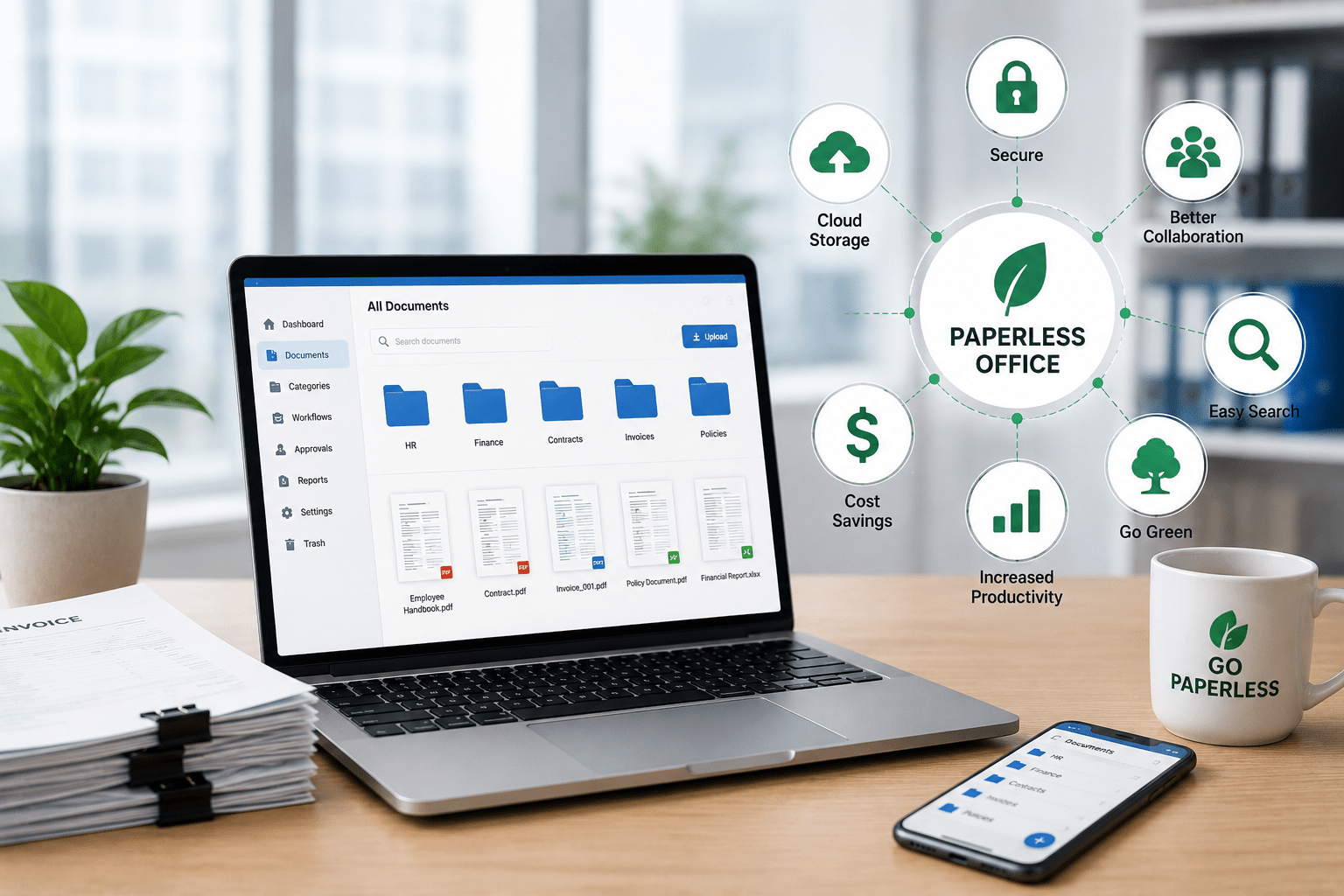
A paperless office can help your business spend less time searching for documents and more time getting work done. Yet paper still arrives every day: invoices, contracts, customer forms, and signed agreements.
Many businesses start scanning but stop halfway because digital files become just as disorganized as paper records.
This guide explains how to create a paperless office in seven practical steps, without disrupting your daily operations.
Key Takeaways
What Is a Paperless Office?
A paperless office is a workplace where documents are received, organized, stored, and retrieved primarily through digital systems.
Physical documents may still arrive, but employees scan or digitally capture them, file them consistently, and retrieve them electronically.
For example, a car dealership may still receive signed paperwork. Instead of storing every document in a filing cabinet, staff can create searchable digital deal jackets.
The goal isn’t zero paper. It’s making documents accessible without depending on physical filing systems.
Why Do Paperless Office Projects Stall?
Businesses often struggle with digitization because they replace paper storage without improving how documents are organized.
Scanning Without Organization Creates Digital Clutter
Scanning hundreds of pages into files named Scan_001.pdf or Invoice_FINAL_v2.pdf doesn’t make them easy to find.
Large PDFs containing several unrelated documents create another problem: employees must search through pages to locate individual records.
Inconsistent Filing Splits Records Across Teams
Without common naming rules, employees create different folders for similar documents.
One person saves invoices by vendor name. Another uses dates. A third keeps everything in a shared folder.
The result is fragmented records and unnecessary searching.
Half-Finished Projects Leave Two Filing Systems
Some businesses digitize new paperwork while keeping older records in cabinets.
Employees must then search both locations. Incoming paper continues accumulating, and the backlog never disappears.
A successful transition needs one consistent process for new documents and a separate plan for older files.
How to Create a Paperless Office in 7 Steps
Converting to a paperless office doesn’t require scanning every document immediately. Start with the work that causes the most delays.
Step 1: Count Your Paper
Identify where your business creates, receives, and stores paper.
Check filing cabinets, storage rooms, desks, and incoming mail. Ask employees which documents are hardest to locate.
Record a few baseline measurements:
Outcome: A clear picture of where digitization could make the biggest difference.
Step 2: Start with One High-Volume Process
Choose one recurring workflow rather than converting the entire business.
Good starting points include dealership deal jackets, vendor invoices, student enrollment forms, or mortgage application files.
Select a process with consistent document types and a responsible team member.
Test the digital workflow using a small group of records. Review what works before expanding.
Outcome: A manageable pilot that helps employees build confidence.
Step 3: Set One Folder Structure and Naming Rule
Digital organization requires consistent rules.
For example, a dealership could use:
Folder: 2026/DealJackets/VIN12345/
Filename: 2026-01-15_VIN12345_BuyerAgreement.pdf
This structure identifies the year, vehicle, document date, and document type.
Choose one format, document it, and share it with everyone responsible for filing.
Avoid complicated folder hierarchies that employees cannot follow consistently.
Outcome: Staff know how documents should be named and where they belong.
Step 4: Choose a Document Management System and Evaluate Paperless Office Solutions
A document management system (DMS) provides a structured place to manage digital business records.
When comparing paperless office solutions, consider:
For more background, see our guide to cloud document management.
Outcome: A system that fits your document volume, team, and workflow requirements.
Step 5: Scan and Digitize Paper Documents in Batches
Don’t attempt to digitize your entire backlog at once.
Prioritize frequently accessed records, divide documents into manageable batches, and assign scanning responsibilities.
As you digitize paper documents:
Outcome: A gradually shrinking backlog without interrupting everyday operations.
Step 6: Stop New Paper Where It Comes In
Prevent new paperwork from rebuilding the backlog.
Replace suitable paper forms with online forms, use electronic signatures where permitted, and encourage vendors to submit invoices electronically.
When physical documents arrive, assign someone to capture and file them through a defined intake process.
Digital intake should become the default wherever practical.
Outcome: Fewer new documents enter physical filing queues.
Step 7: Train the Team
Even the best filing system needs employees who understand how to use it.
Show staff how to name, upload, search, and retrieve documents. Let them practice with representative files.
Assign a team member to answer questions and review filing consistency.
Update training materials when workflows change or new employees join.
Outcome: A consistent process employees can follow during daily work.
What Are the Benefits of Going Paperless?
The benefits of going paperless extend beyond reducing physical storage.
| Before | With organized digital workflows |
|---|---|
| Search through cabinets | Search indexed digital records |
| Manually route paper files | Share records with authorized staff |
| Maintain inconsistent filenames | Apply common naming rules |
| Track document changes manually | Use version histories where supported |
| Store growing paper backlogs | Digitize and retain records according to policy |
Businesses may reduce administrative effort, improve document visibility, and make records easier to retrieve.
Actual savings depend on existing processes, document volume, and employee adoption.
Learn more about the benefits of document management.
How Does a Paperless Office Work Across Different Industries?
Different industries manage different records, but the foundation is similar: consistent organization and reliable retrieval.
Car Dealerships
Dealerships handle buyer agreements, titles, deal jackets, and vendor invoices. Organizing records by VIN helps staff locate vehicle-related paperwork.
Dealerships that finance or facilitate consumer vehicle financing may also have obligations under the FTC Safeguards Rule.
Read our guide to car dealership DMS.
Schools
Schools manage enrollment forms, transcripts, attendance records, and administrative documents.
Indexing student records by student ID can improve retrieval for authorized staff. Appropriate access controls and recordkeeping practices support FERPA-related obligations.
Healthcare Practices
Healthcare practices handle patient forms, insurance correspondence, and billing records.
Organizing documents by patient ID and date of service can help administrative teams retrieve information while maintaining appropriate access restrictions.
Government Offices
Government departments manage permits, licenses, applications, and public records.
Indexing permits by permit number can simplify document retrieval and support records-request workflows, subject to applicable disclosure rules.
Finance Firms
Finance teams manage account statements, loan applications, contracts, and supporting records.
Using account or loan IDs helps staff organize client documentation and respond to authorized requests.
Law Firms
Law firms maintain client correspondence, contracts, pleadings, and matter records.
Organizing files by case number or matter ID can reduce searching across paper folders and email attachments.
Learn more about legal document management.
What Recordkeeping Rules Should Businesses Consider?
Going paperless does not automatically establish regulatory compliance.
Several US rules affect electronic records:
Organizations must also follow applicable retention, security, access, and disposal requirements.
This article is not legal advice. Federal, state, and industry rules vary. Confirm your requirements with an attorney or compliance advisor.
How Docupile Supports a Paperless Office
Docupile helps businesses organize and manage digital documents through a centralized document management platform.
Its available capabilities include AI-assisted file naming, automated folder creation, PDF splitting and sorting, OCR, metadata indexing, and document search.
Teams can also use document permissions, audit logs, retention features, and workflows to support their records-management processes.
These tools can reduce repetitive document-handling tasks while allowing businesses to maintain consistent filing practices.
Specific automation settings and workflow suitability depend on the documents and implementation.
Conclusion: Start Your Paperless Office One Process at a Time
A paperless office begins with understanding your paperwork, choosing one high-volume process, and establishing consistent filing rules.
You don’t need to digitize everything overnight. A clear intake process, organized records, suitable technology, and staff training can make the transition manageable.
See how Docupile files, names, and finds your documents: book a free demo.


